ALL DRAGONS ARE MADE OF CHEESE
TAGS, TAXONOMIES, AND INESCAPABLE HOLES
WEEK 4 BLOG POST

THE ARCHIVE IS MADE OF GREEN CHEESE (3)
If you search the keyword “龍” (the traditional Chinese character for dragon) in the “Tapestries and embroidery” section via the National Palace Museum’s OpenData archive, you’ll see 12 artefacts. If you conduct the same keyword search with the pinyin “long”, you will get two results – neither of which were included in the previous results! (1) And if you search for “dragon”, you’ll get no results at all.
All of this occurs after I’ve set the OpenData website to English mode. Which makes this discrepancy weird, but it also kind of makes sense. Of course the digital archive of one of the most famous museums in a predominantly Mandarin-speaking country would prioritise its Mandarin metadata. There are 400+ artefacts in the tapestries & embroidery section alone, and clearly English translations aren’t a priority considering most of the artefact metadata (besides its name) is still in Mandarin, even in English mode.
This is an illustration of prejudice being encoded into an archive. Prejudice in the Hans-Georg Gadamerian sense, as in the built-in natural assumptions and priorities everyone perceives the world through, which aren’t strictly flaws but need to be kept in mind during interpretation. Detailed English translations of all metadata simply aren’t a priority for this archive, especially in a world where browser translators exist, even if it might limit understanding for international audiences. NPM OpenData is great – it has provided information on over 410,000 artefacts for free since 2013 and allows unrestricted public/commercial use as long as proper source credit is included. (2) The NPM team is choosing to foreground developing these resources instead of strengthening accessibility for English-speaking users; this, in my opinion, is an understandable choice.
However, observing this weakness inspired me to question deeper biases within the archive. As the National Archive article on “Intrinsic Value in Archival Material” and Peel Archives’ piece titled “What do archivists keep (or not)?” detail, archives are never neutral. Each archivist’s curatorial logic is shaped by their personal preferences, context, and the institutional rules that govern them.
The full history of the NPM can be found on their website here (4). This is an abridged version:
After Puyi (the last Chinese emperor) and the royal family were pushed out of the Forbidden City (the “national palace”, so to say) by Sun Yat-sen’s revolution, the Republic of China was established and put an end to Chinese dynastic rule. The National Palace Museum was officially founded in the Forbidden City on October 10, 1925 – ROC’s national holiday.
This is significant because the curatorial bias within NPM’s archive has much higher stakes than “are their opinions sufficient.” These top Nationalist government and museum officials were operating under timed conditions, and not even all the selected pieces made their way to the NPM we know today. It’s an incomplete top sample – and top sampling has issues in and of itself (6). My utilisation of other archives and sources has now graduated from “would be nice” to “incredibly necessary.” As much as I love it, there are certainly holes in the NPM’s collection that could be assisted by bringing in multiple sources and perspectives.
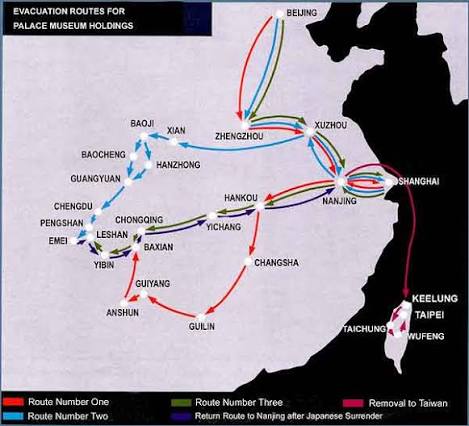
In 1931, the Japanese Kwantung army invaded northeastern China, posing a threat to the capital (Pingjin, now known as Beijing). As such, the artefacts were divided into three batches and moved to Shanghai.
In 1937, the Second Sino-Japanese War forced the relocation of the artefacts again from battle areas.
After WW2 ended (1945), there was a brief period of respite where the artefacts were gathered in Chongqing to be returned to Nanjing via sea transport.
Significantly, the 1948 conflict between the CCP (共產黨) and the KMT (國民黨) caused the most prized items to be sent to Taiwan. By the time the items arrived in Taiwan, the Communist army had already seized control of the National Palace Museum collection in Beijing, so not all could be sent. The total of 2,972 crates accounted for only 22% of the crates originally transported south, although the pieces represented “some of the very best of the collection” (5). According to my tour guide, all artefacts only sustained minimal damage after all this travel, which I found very impressive.
The museum opened for public viewing in March 1957.
SILENCE AND POWER DYNAMICS
That said, as an institutionally run archive, it is certainly still necessary to question the curatorial methodology. As Michel-Rolph Trouillot says in his book Silencing the Past, “the past does not exist independently from the present” (p15). The former cannot exist without being developed by the latter.
Sans Souci is a man and Sans Souci is a palace in Germany and Sans Souci is a ruin crumbling in rural Haiti. King Henry I of Haiti had Jean-Baptiste Sans Souci killed in 1803, and later built Sans-Souci Palace near, or possibly on, the site associated with that killing. (7) The three are “knowable” in different ways (the Germanic palace is best preserved, the ruin holds historical value), but what Trouillot makes clear is that when most tour guides speak of Sans Souci, the palace, they do not mention the man at all. “Almost every mention of …the palace, the very resilience of the physical structure itself, effectively silences Sans Souci, the man, his political goals, his military genius” (p48).
Trouillot goes on to add that silence is inherent in history; every event is recorded at the expense of another fact. It is clear that this silence is not made equal. How much power you wield determines how much of you is knowable historically – San Souci (the Germanic palace) was preserved by the descendants of Prussian King Frederick the Great immediately after its death, allowing both a “materiality” that history can easily explain and acknowledge (p45). Sans Souci, the military leader, executed by a rival after arriving at what he believed was a peaceful meeting, is survived by a Wikipedia page barely 2 pages long. (8)
Isn’t it likely such power dynamics may be encoded within dragons as well? The dragons I know best, that I immediately recognise as the Chinese dragon, are all imperial dragons. It is common sense that Chinese dragons are associated with emperors. Is this unambiguously true? Could there be other dragons that didn’t receive such treatment because they didn’t belong to those in power? (9) This is something I plan on following up on and exploring in my final archive.


LET’S GET FICCY!
A useful point of comparison against NPM’s Open Data is Archive of our Own (AO3) – a noncommercial and nonprofit central hosting place for fanworks using open-source archiving software, as described on the Organisation for Transformative Works (OTW) website. (10) The Archive recently exited open beta and currently has over 11.3 million registered users and more than 18 million works posted across over 81,300 fandoms. The OTW also manages several other fandom-related projects, such as Fanlore, a wiki focused on fandom and fanwork history, and Legal Advocacy, which aims to protect and defend fanworks from commercial exploitation and legal challenges.
Ao3 strikes a sharp contrast to NPM’s institutional framework as a community archive that’s managed mostly from the bottom-up. It balances between pseudo-social media and traditional archive, most notably in its user-generated tagging – what Murtha Baca describes as “folksonomy”, which are “collaborative, decentralised, and naturally evolve based on how the community uses and describes the content.”(11) This gives creators and readers a lot of autonomy: they get full control over how to define their work, how it’s perceived, and which audiences can see them (for example, some authors choose to ‘lock’ their posts, meaning the work will be hidden from general Google searches). To prevent user error, a team of dedicated “tag wranglers” helps group duplicate tags into one – such as combining ‘Coffee Shop AU" and ‘Alternate Universe - Coffee Shop’. Combined with thorough filters, Ao3 has one of the most robust search and filter systems in the current fanwork space. (12)
Other notable features:
one-click downloads of fanworks in multiple formats (ePub, HTML, Mobi, PDF)
commenting, kudos (equivalent to a “like” that you can give to fics), and bookmarking (saving privately)
hosting fanwork collections and challenges
the ability to mark works for later
the ability to create and curate collections of works with any theming you like
the ability to subscribe to users, works, and series

Baca specifically notes that the main goal of metadata is to make information searchable, findable, organised, and informative. While I’ve just demonstrated Ao3 has endeavoured to (and in many aspects succeeded in) accomplishing these requirements, an unavoidable fact of folksonomy is that people can mess up. In 2021, the fic Sexy times with Wangxian was posted with approximately 4400 tags, many of which were irrelevant fandoms, K-pop groups, and random phrases to game search visibility. The fic took up large amounts of screen space on search results and tag pages, and some users even reported page loading problems on their devices. In August 2021, Ao3 officially instated a 75 tag limit for every work. (13)
While this example is the most infamous and ridiculous, such instances of tag misuse are not unique. Clearly, users’ ability to find and retrieve relevant objects was hindered. Unfortunately, such a situation is statistically innate – it is not as if every user is given metadata training before joining the site, and there is only so much volunteer moderators can do. When one gives up institutional control, they also give up institutional organisation; one is not necessarily better than the other as a whole, but each is better fit for different situations.
Ultimately, both types of archival organisation are equally necessary. While my personal archive will lean towards organised curation and control, I continue to hold decentralised archives like Ao3 in high esteem(14), especially how it prioritises undervalued ways of knowing.

(This incident was so notorious one user built a site that randomly generates real tags from the fic! You can find it linked here. It’s pretty unbelievable.)
(Qualifications include: using this site for a darn long time!)

It’s become clear that this project can’t lean on any single archive, or any single kind of scholarship. Baca has influenced me to deeply consider what my own metadata choices will promise or withhold; Trouillot paired with the National Archives and Peel Archive's appraisal criteria gives me a vocabulary for the exclusions baked into every archive. I aim to continue engaging with all these scholars and methods, especially once I start pulling further qualitative research.
WORKS CITED
https://medium.com/@bdergis/archive-of-our-own-as-an-archive-and-social-media-platform-11d3c0ddac10
https://archiveofourown.org/admin_posts/34626:
https://en.wikipedia.org/wiki/National_Palace_Museum
https://peelarchivesblog.com/2018/04/04/what-do-archivists-keep-or-not/
http://www.getty.edu/publications/intrometadata
https://www.reddit.com/r/FanFiction/comments/paz5ye/ao3_is_implementing_a_tagging_limit_how_do_you/
FOOTNOTES