
AND HELLO TO INFORMED FAMILIARITY!
CONCLUSION: FINDINGS & FURTHER INQUIRY
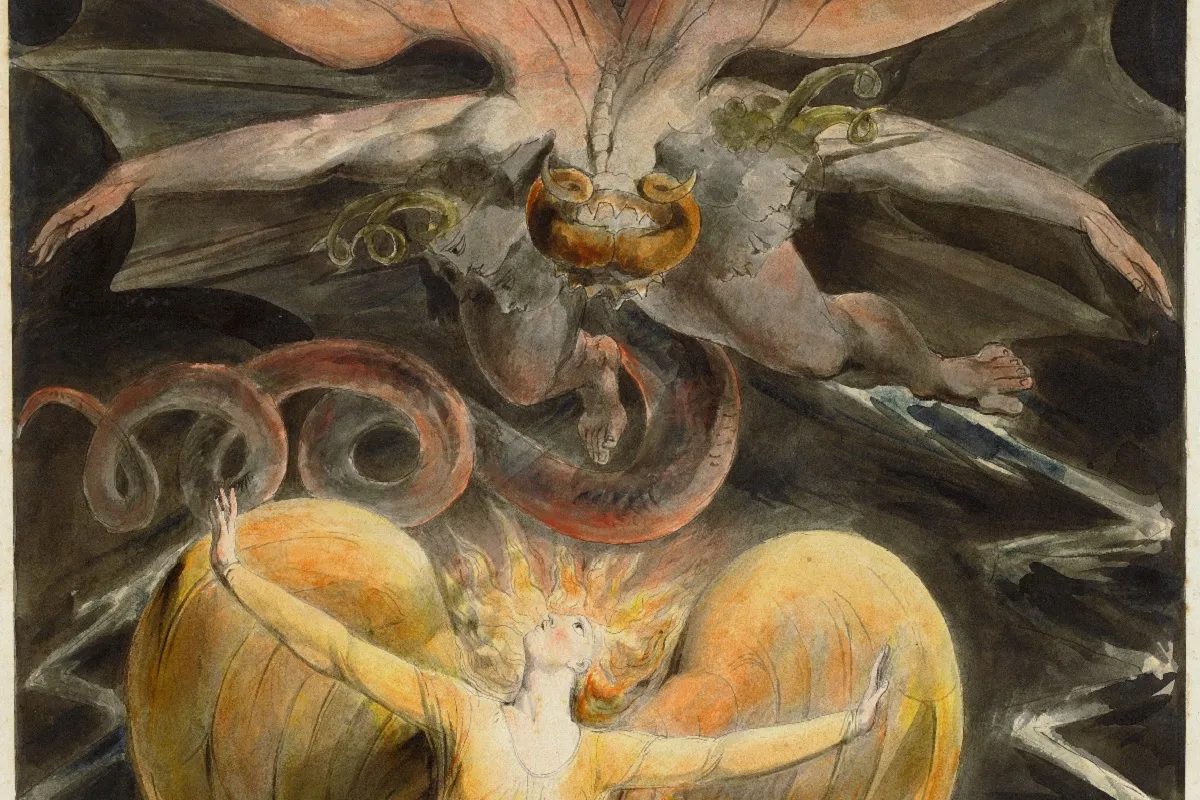
William Blake: The Great Red Dragon and the Woman clothed in the Sun
DYNASTIC CHINA
fertility/life-force symbol, prestigious but no concrete political meaning (Hongshan)
→ protective/auspicious use in ritual life (Gui)
→ first explicit claim of the dragon as imperial mandate (Seal)
→ imperial claim hardens into strict, aggressively enforced laws (Robe)
→ the symbol crosses into Europe and gets reshaped by people who never had the original context (Basin).
CHRISTIAN EUROPE
primordial chaos-monster, needed to be defeated to establish cosmic order (Baal Cycle)
→ explicitly named as Satan, but the visual form hasn't settled yet — still serpentine (Beatus)
→ religious and secular understandings synthesise: fire-breathing, hoard-guarding, heroic-to-slay (Beowulf)
→ the symbol persists in intimate, daily life (Prayer Book)
→ the form gets stylised and further entangled with pagan stories, as well as Renaissance intellectual pursuits (Uccello).
Looking at the timelines, a clear narrative emerges:
The results of my research have only led to more questions:
I noted in my data dictionary how dynastic Chinese art tends to credit a group, rather than specific artists. Is there demonstrated evidence that Christian European art tends to prioritise individualism? Are there cultural, philosophical, or political normalities that motivate this difference?
The association between imperial power and dragons in dynastic China far predates even the conception of Satan as a dragon on the Christian European side. How was this consistency maintained?
Could these cultural differences be due to environmental factors? Perhaps different behaviours in wildlife or weather contribute to how the “serpentine” (which is demonstrated to have inspired both chronologies) are perceived?
If dragons are so significant to both dynastic Chinese and Christian European contexts — as either a protector or a villain — how come modern dragons inspired by Christian European traditions have been able to break out of the reverence hierarchy, able to be beloved, criticised, or complicated even by explicitly Christian artists (see: Dragons in our Midst)? Why is the gap between “villain” and “character” easier to close than the gap between it and “emperor”?
I don’t have a clear answer, but our timeline has provided me with a couple of theories. We can observe how early on pagan and Christian traditions would intertwine: the story of St George is a great example of a spiritual figure being cast in an accessible narrative. Could the normalisation of religious figures in narrative make it easier to manipulate those same figures creatively down the line? Alternatively, perhaps it is simply easier to “play” with villainous characters because such figures don’t really demand respect. You are not punished for incorrectly depicting Satan as a Leviathan, although you might receive social pushback for glamorising them, which is still a lower bar of entry than execution.
But those theories need further research to be verified, which — considering this project is a ‘proof of concept’ developed over six weeks, most of which were spent learning the theory and practices of archiving — is far beyond my scope. I encourage you to check out further reading on this page.
In sum, when I continue this project, the clearest next step is to finish translating the English content into Mandarin, and using the open questions above as starting points for a longer version of this archive.
While both cultures start with serpentine shapes for their dragons, they quickly diverge. Both cultures move fast to attach a value judgment: within centuries, China's dragon is claimed by everything associated with legitimate power — luck, weather, harvest, eventually the emperor himself — while Europe's is folded into Revelation's imagery of Satan. Then, each culture backs that choice: China with law (i.e., the claw hierarchy) and Europe with doctrine and convention, granting its dragon slightly more flexibility. Nobody was imprisoned for painting a sympathetic dragon, after all.
Another key observation I want to point out has to do with the porcelain basin and chinoiserie. If reverence without engagement is one failure (a form of objectification), this timeline shows that engagement without understanding is a failure as well. European artists, intrigued by the Chinese long adapted it to their own culture by imposing their own dragon associations and traditions. Did they do this out of ignorance, malice, or creative intention? Does it matter, or is the end distortion disrespectful regardless?
I don’t want to come off as approving of cultural appropriation. I think that if the chinoiserie artists genuinely studied and appreciated the Chinese long and created merged cross-cultural dragons in an intentional, meaningful way, that may be something interesting and significant. But, at least according to the contemporary scholarly consensus, the changes made likely came from a lack of understanding; still cultural erasure.
POSTSCRIPT: ACCESSIBILITY
One struggle was balancing the aesthetics of the site with accessibility. This was very important, as I mentioned in the introduction, how I wanted this site to be accessible and enjoyable for the “everyman”, who doesn’t want to dig through an institutional archive to find what they’re interested in — or struggle with technical difficulties.
For example, I really loved having the porcelain tiles in the background: I think it makes the site stand out and matches the themes of the project really well. However, it is a very bright pattern that may be distracting to readers. I thus opted to place a cream box in the centre of the screen for my text and content to stand out, and placed a dark overlay over the tiles to prevent it from being draining on the eyes.
Similarly, in my metadata section, I labelled my images descriptively rather than using generic filenames, so that those using a text reader would still understand what I’m trying to convey. Translation gaps are also stated explicitly for full transparency, as knowing where a translation might have introduced loss could help them know to take the information with the slightest pinch of salt.
I found it interesting how accessibility — although certainly tedious — ultimately came as a natural result of me trying to create the archive I envisioned at the beginning of this course.
This archive isn't meant to hand you a finished, correct way to engage with either dragon. It's handing you the beginnings of the actual history, so that you have a solid foundation to explore whatever foundation piques your interest. My hope is that whatever you do next with these symbols, playful or serious, comes from curiosity and passion rather than from distance or projection.
POSTSCRIPT: LOOKING FORWARD
I can’t help but think about how, in its current state, my project is a bit precarious. If I stop paying for/maintaining a server for Omeka, my close reading database will disappear. If I stop paying for Framer, my gallery would go poof. Thankfully, all my writeups (essays, data dictionary, metadata) are preserved in text documents, so those won’t go missing unless I lose my physical laptop.
If I ever sunset my project, I’ll likely take the low-friction, default route we discussed in class: turning the Omeka and Framer exhibitions into static sites with my digital writeups attached. I’ll have to accept that my visual styling (ex., the porcelain background and cinnabar connectors) will not survive. But that’s alright, I think. Those properties were experiential, not archival, so while they’re nice, they’re not necessary. Thankfully, unlike when the National Palace Museum had to select the most significant properties of their archive, I expect that when my archive must be sunsetted, I will be able to do so on my own timeline.
